Coastal emergencies can strike at any time, turning a lovely day out into a nightmare in seconds. Nobody thinks it will happen to them but it usually happens to somebody and that somebody could be you.
Taking a brief moment to prepare before you set out will give you and your loved ones the best chance of helping to save the life of anyone you see in danger as well as yourselves.
The HM Coastguard officers in the operations rooms have a world-class array of systems and equipment to help them locate you, but precious minutes can be saved if you can give them as much information as possible, quickly and clearly.
Our teams use advanced technology to assist with search and rescue response but if the 999 caller can tell us their exact location immediately, it can save valuable time in dispatching the most appropriate responders. We urge everyone who visits the coast to have a think ahead of time about what they will tell us if they do need to call for help. For example, are there any significant landmarks, specific names and location information you can tell us about that will help to pinpoint where you are very quickly.
Richard Wasson, HM Coastguard’s Community Safety Lead.
This is particularly important if you are away from home and may not be aware of the names of certain locations. Having a fully charged mobile phone on your person is key. Any additional devices such as a personal locator beacon can also be a significant aid to help us to help you, particularly in remote areas without phone signal.
When you call 999 and ask for the Coastguard, one of the first questions will be “where are you?” The moment you provide that information, the teams will be dispatching the most appropriate responders. There are very simple ways (as well as more sophisticated options) to help you stay safe and know your location.
Know where you are. Four easy top tips
Before you leave. Tell someone
Ideally go with someone else, not alone. Before you leave home, tell someone where you are going and when you expect to return.
Safety signs and location
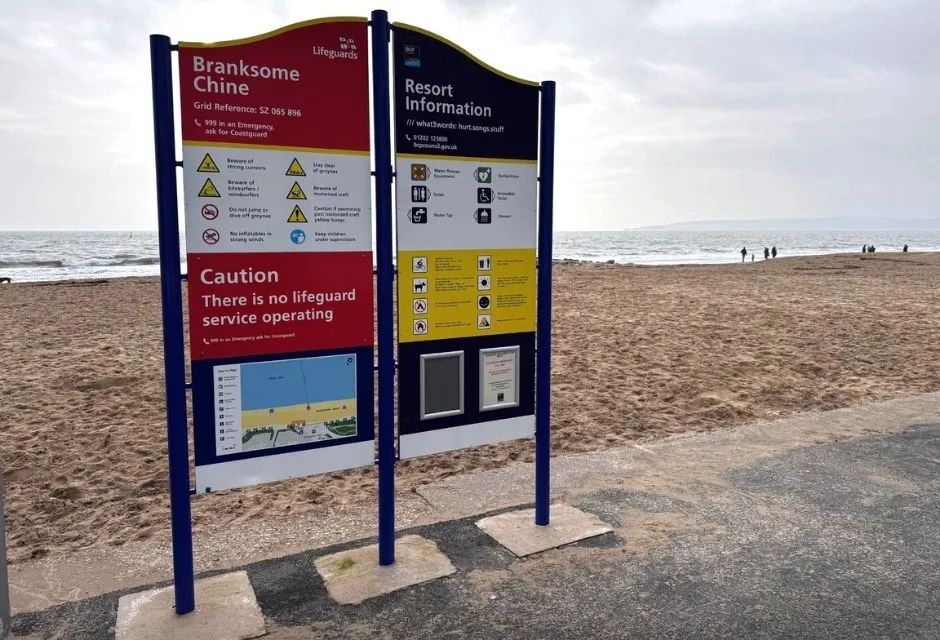
Look for local safety signs depicting beach names and location references. It’s a good idea to take a photo of any signage so you can refer back to it to help you explain where you are in an emergency. Make a note and take a picture of local landmarks such as car park names, buildings such as cafes or public toilets and geographical landmarks such as sand dunes.
Location apps and Ordnance Survey (OS) grid references

If you are using an app it’s a good idea to practice with it before you might need it. Be aware that in remote areas you might not have mobile data available for using apps although you may still have the ability to call 999.
The most reliable way to give HM Coastguard your location is by providing the six figure OS Grid Reference. For example, a BCP Council beach safety sign at Branksome Chine in Poole (pictured below) shows the grid reference of SZ 065 896.
In Northern Ireland, the system is slightly different. The area of Northern Ireland is divided into lettered squares, measuring 100km by 100km, each identified by a single letter. A grid reference would normally be described by the box letter followed by the units of measure in metres. An example grid reference would be J 338 740.
Many smartphones now have GPS installed (Global Positioning System which pinpoints geographical locations) and other widely available apps are really useful such as Google Maps, Apple Maps, OS Locate and What3Words. And in the future, Ofcom has announced that satellite calling will be available in the UK. This involves satellites hundreds of miles above Earth beaming down signals to smartphones, so they can make calls, send texts and use data in ‘not-spots’ where there’s no mobile coverage.
Mobile phone

Make sure your mobile phone is fully charged and ideally in a waterproof case. It's also worth taking a power pack so you can recharge your phone, especially if your activities involve heavy battery use.
Know where you are. Extra Safety Tech
Many of us enjoy exploring the coast and getting away from it all. But the downside is there may not be anyone around to help if something goes wrong in a remote location and a good chance you may not have a phone signal. What then?
PLB (Personal Locator Beacon)
Increasingly affordable and compact, these units will work even in remote locations. In the UK if you get into difficulty, you can set it off and HM Coastguard will be alerted, with your location.
VHF Marine Radio with digital selective calling
Essential for all boaters and those going afloat.
EPIRB (Emergency Positioning Indicating Radio Beacon)
Emergency positioning indicating radio beacon. An essential piece of kit for vessels. You need to register it to your vessel. When activated, it will transmit the position of the vessel to HM Coastguard. Register your beacon on GOV.UK now.
The OS Grid Reference explained
Pinpoint your location: Ordnance Survey (OS) Grid Reference with HM Coastguard, the Ordnance Survey’s Grid Reference is the most reliable.
The Ordnance Survey National Grid System is a way of pinpointing a location. It divides the country into a series of squares, each identified by letters and numbers. You can see it on a paper map and there’s also a phone app on which you can download and save an offline map for use if there’s no mobile phone signal.
Read more:
Safety spotlight – ‘Tech up’ in case of trouble | HM Coastguard UK
Out of range but not out of touch – Alan’s rescue | HM Coastguard UK